
A structural drainage problem goes beyond a soggy yard. It threatens your foundation directly. We have been working on Front Range homes since 2001, and we can tell you from experience that water management failures and foundation damage almost always show up together. Below are five signs that tell you whether what you're seeing is cosmetic or something that needs serious attention.
Concerned your drainage issue is structural? Schedule a free on-site inspection. We'll give you a straight answer.

How Do You Know If Drainage Is Damaging Your Foundation?
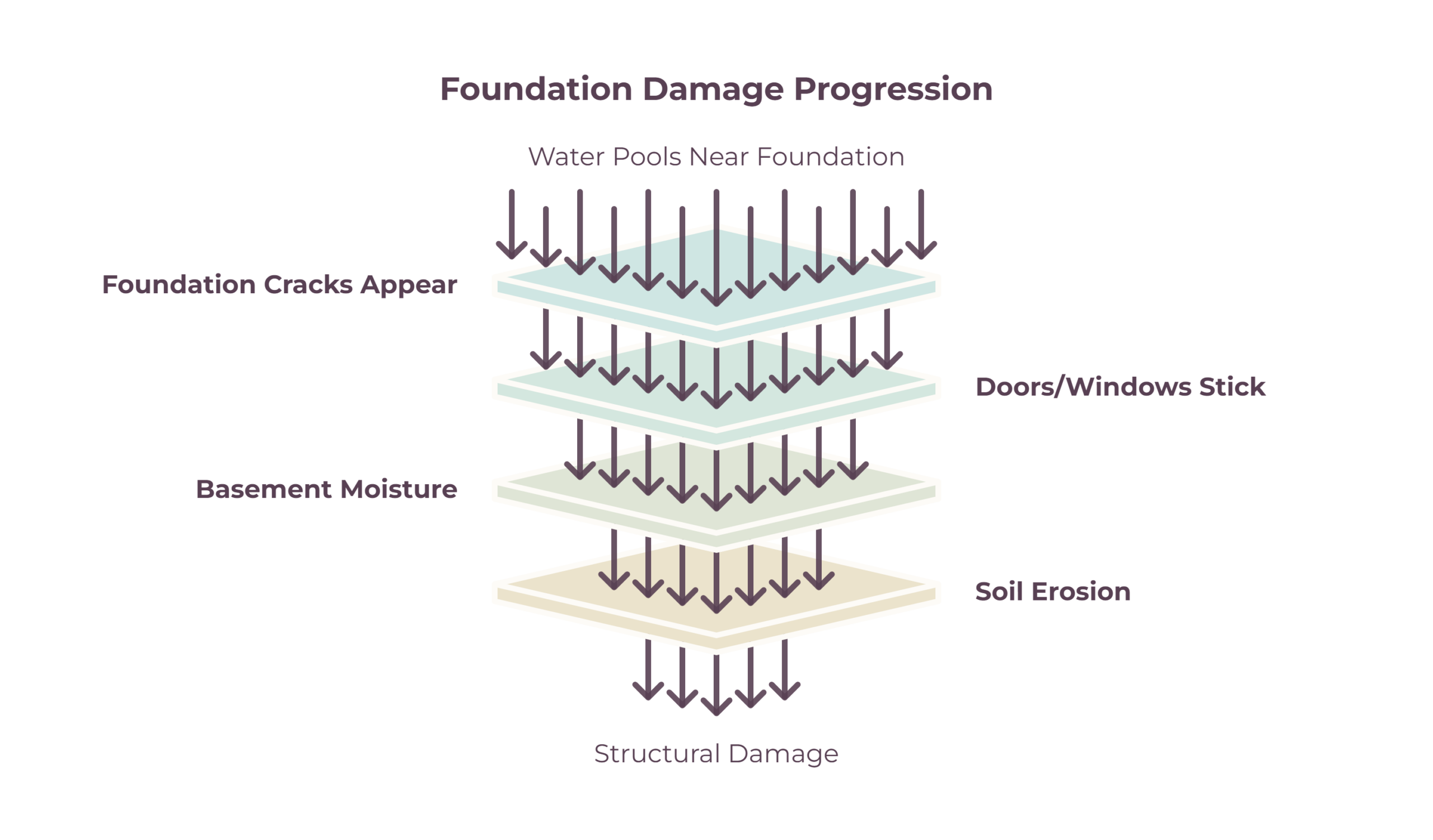
A structural drainage problem goes beyond standing water. It includes foundation cracks that appear or grow after wet seasons, doors and windows that no longer close square, moisture or efflorescence in your basement or crawl space, and soil visibly eroding at the footing line. If you're seeing any of these, the issue likely extends below grade.
Why Front Range Soil Makes Drainage More Than a Landscaping Issue
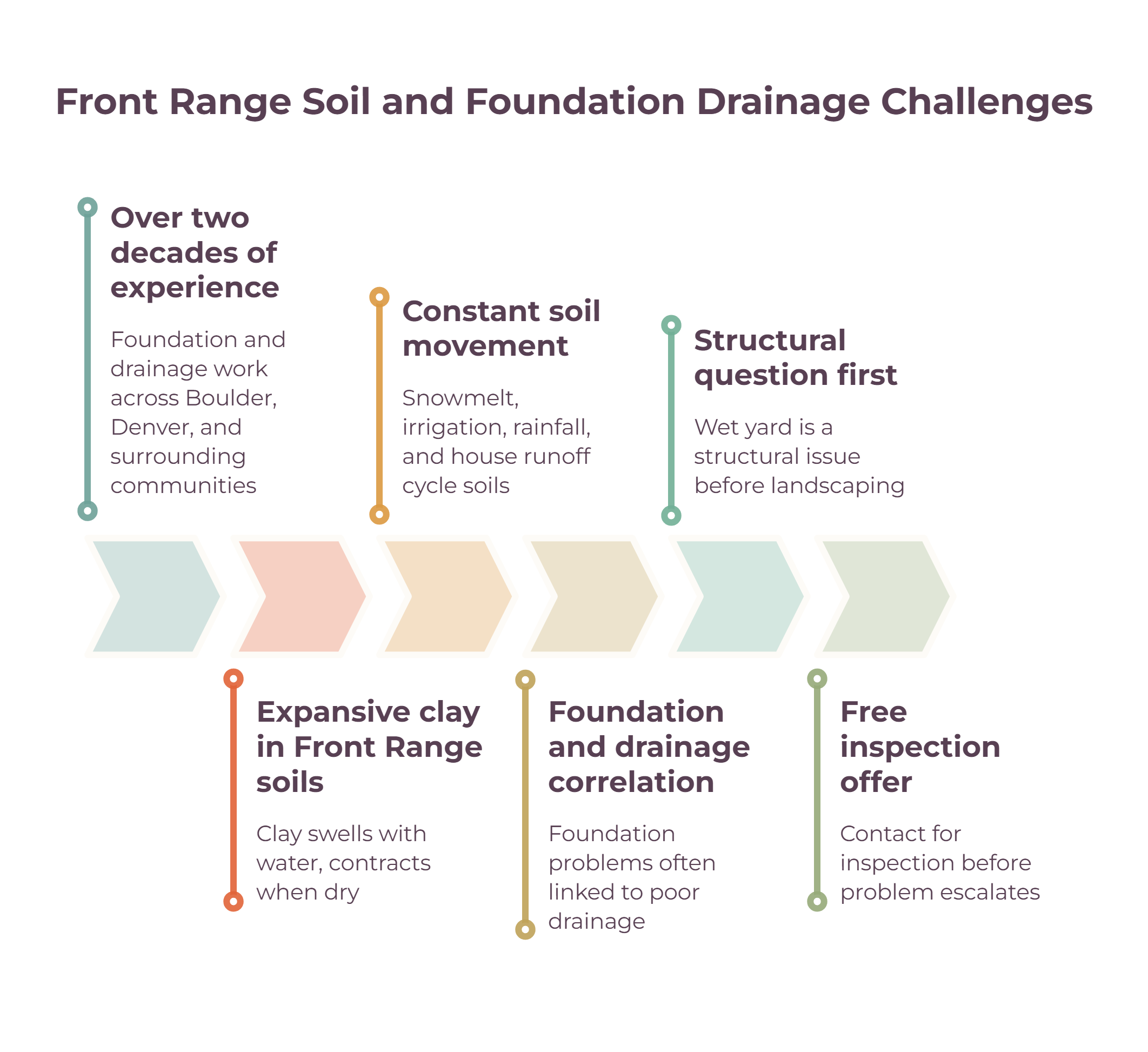
After more than two decades of foundation and drainage work across Boulder, Denver, and surrounding communities, we can tell you the movement almost always traces back to one thing: water reaching the clay.
Front Range soils are loaded with expansive clay. That clay swells when it takes on water and contracts when it dries out. Snowmelt, irrigation, rainfall, and water shed off the house all cycle those soils repeatedly between wet and dry. That constant movement pushes on foundation walls and footings in ways that generic drainage advice, written for other climates, simply doesn't account for.
We almost never go to a home in Colorado that has a foundation problem and good drainage. Those two things just seldom exist together. That's not a coincidence. It's the geology. This is why a wet yard on the Front Range is a structural question first and a landscaping question second.
If you see any of the five signs below, contact us for a free inspection before the problem goes further.
Sign 1: Water Pools Near Your Foundation After Every Rain
Water that collects within a few feet of your foundation after rain and does not drain within 24 to 48 hours is working against your structure. When water follows the same path toward the house after every storm, you are watching a grading problem in real time.
Poor drainage and grading sends water directly into the clay soils against your foundation walls. Saturated clay swells and pushes laterally on those walls, setting up cracking and movement that builds season after season. By the time cracks appear inside, the process has often been going on for years.

This is usually the first visible warning sign, and it's the one homeowners are most likely to wait on. Do not. Our drainage and grading services address the surface grading and flow paths that determine whether water moves away from your home or straight toward it.
Sign 2: Foundation Cracks That Appeared or Grew After a Wet Season
Not all cracks mean the same thing. Hairline cracks in poured concrete are common and often cosmetic. What concerns us are horizontal cracks in block or poured walls, stair-step cracks in brick or block, and vertical cracks that widen unevenly across seasons.
The cause and effect is straightforward. Saturated clay expands and pushes against foundation walls with significant lateral force. Over time, that pressure causes walls to crack, bow, or shift. When you see a crack appear or grow following a particularly wet spring or summer, poor drainage sending water to the clay is almost always part of the story.
For a full picture of what different crack types indicate, see our page on signs of foundation damage.
When to Call a Structural Engineer Before Calling a Contractor
If cracks are wider than a quarter inch, horizontal, or have been growing across multiple seasons, call a structural engineer before calling a contractor. An engineer evaluates the structural integrity of your foundation, produces stamped drawings, and defines the repair scope. A contractor executes that scope.
We work in close coordination with independent structural engineers, and we have built much of our reputation through engineer referrals. Getting an engineer involved early isn't a barrier. It protects you and makes sure the repair is designed correctly from the start.
Sign 3: Doors and Windows That Stick or No Longer Close Square
Foundation movement from soil saturation often shows up in door and window frames before it shows up in the foundation itself. When the structure shifts even slightly, door frames rack out of square. Doors stick at the top corner. Windows become difficult to open. Gaps appear between the frame and the surrounding wall.
Most homeowners chalk this up to humidity or normal settling. Sometimes it is. But when it appears alongside other signs on this list, or when it develops during or after a wet season, it's worth treating as a structural signal. The frame is telling you the structure beneath it has moved.
Not sure where your problem sits? Contact us for a free inspection. No obligation, no pressure. We'll tell you honestly what we find.
Sign 4: Moisture, Efflorescence, or Seepage in the Basement or Crawl Space
White mineral deposits on your concrete walls are called efflorescence. They form when water moves through the masonry, carrying dissolved salts to the surface. It's a clear sign that water is working through your foundation walls, not just collecting outside them.
Other signals in this category include damp basement floors, a persistent musty smell, and visible water intrusion at the base of a wall or in a crawl space. When surface drainage isn't directing water away from the home, hydrostatic pressure builds against the foundation and water finds every available path inward. Drainage work that only addresses the yard, without fixing the underlying source of pressure, leaves this problem in place.
Basement waterproofing addresses moisture that has already reached the interior, but it works best when paired with correcting the exterior drainage that drives the pressure.

The Role of Underground Gutter Drainage in Basement Moisture
Underground gutter drainage pipes carry roof runoff away from the foundation. Over time, those pipes can fail from root intrusion, soil settlement, or simple pipe deterioration. When they do, every rainstorm discharges water directly at the footing, exactly where you don't want it.
Homeowners looking for underground gutter drainage repair are often dealing with this exact failure. It's one of the more common causes of basement moisture we find on site. Our foundation drain systems address both the failed underground drainage and the resulting structural pressure.
Sign 5: Visible Soil Erosion or Voids Along the Foundation Perimeter
Exposed footings, gaps between the soil and the foundation wall, and eroded channels along the drip line are signs that water has already been doing damage below grade. When the yard has settled and pulled away from the house, the soil that was supporting the structure has moved.
Erosion at the footing line means water has been cutting through bearing soil, not just running across the surface. What you see above ground reflects a process that has been happening underground for some time. Surface-level yard and lawn drainage repair addresses the visible erosion, but the full picture requires understanding what has happened below the footing. That's the diagnostic step most contractors skip.
Surface Drainage vs. Structural Drainage: What Is Actually Different
The difference matters because the fix is different. Use this table to locate where your situation falls.
| Surface (Cosmetic) Drainage | Structural Drainage Problem | |
|---|---|---|
| Location | Low spots in yard, garden beds, patio | Near foundation, against basement walls, crawl space |
| Duration | Dries within a day | Stands 24 to 48+ hours or recurs in same spots |
| Damage risk | Turf stress, plant loss | Foundation movement, wall cracks, moisture intrusion |
| What is needed | Minor grading, soil amendments | Integrated drainage system, foundation assessment |
A structural drainage problem exists when water management failures create conditions that weaken your foundation, walls, or structural framing over time. For a deeper comparison, our post on French drains vs. yard drainage in Colorado breaks down which systems address which problems.
Why a Permanent Fix Starts With the Right Diagnosis
A surface-only drainage fix installed over an undiagnosed structural problem tends to fail, and often quickly. We have seen it repeatedly. Water finds a new path, pressure rebuilds, and the homeowner is back where they started.
We have worked on homes built across every Front Range construction era, from the 1870s through recent builds. That range of experience means we read a site differently than a contractor who only works below grade. We look at surface grading, underground drainage, foundation wall condition, basement and crawl space moisture, and soil behavior as a single connected system. Our chief goal is quality and longevity. We only want to fix anything once.
When drainage damage has already caused foundation movement, we bring in limited-access micropiles as the permanent structural solution. Very few foundation companies install them, and they're the gold standard for long-term stability.
For a clear picture of what is at stake financially when drainage is ignored, our post on the cost of ignoring drainage problems walks through the progression. This is the reason we diagnose before we design.
Van Matre Construction: Drainage Services and Repairs Built for the Front Range
We have provided drainage services and repairs across Boulder, Denver, and the surrounding Front Range since 2001, including Lafayette, Louisville, Longmont, Broomfield, Westminster, Superior, Arvada, Erie, and Northglenn. Our field estimators, Tim and Lance, have each been with us more than 20 years, and together we bring decades of field experience to every project. We're rated A+ by the Better Business Bureau and carry an exceptionally high Google satisfaction rating from verified customers.
We got started in foundation repair through referrals from independent engineers, and that relationship still defines how we work. Engineers trust us to execute their designs without shortcuts or substitutions. If you're already working with a structural engineer, we know how to step into that process.

Not Sure Which Problem You Have? Schedule a Free On-Site Inspection
If you have recognized any of these signs, the lowest-risk next step is getting expert eyes on the problem. The inspection is free, and we'll give you a straight assessment of whether your situation is cosmetic, structural, or somewhere in between.
We're longtime Front Range residents. When we see you at the grocery store, we want you to smile and shake our hand. That's what drives how we work. If you're wondering whether a drainage issue is more serious than it looks, reach out and find out.