
Skipping a proper site diagnosis is the single most common reason drainage systems fail within a season or two of installation.
A homeowner pays for the work, the water comes back, and now they're dealing with the original problem plus the cost of removing or working around a system that didn't solve anything.
Most of the time, that failure wasn't a bad product or a sloppy installation. It was a guess that turned out wrong.

Skipped Diagnosis Is the Leading Cause of Drainage Failure
When a contractor installs a drainage system without first understanding where water originates, how it moves through the soil, and how it interacts with the structure, the solution is a guess. Guesses fail.
After more than two decades on the Front Range, we can tell you that drainage failures are almost never material failures. They're diagnostic ones.
Why Drainage Work Fails More Often Than It Should
Drainage work can look straightforward from the outside. Install a French drain, add a swale, reroute a downspout. The problem is that none of those solutions hold up long-term unless someone has first traced the complete water story of the property.
In more than two decades on the Front Range, we have seen the same pattern on job after job: when a foundation is moving, it almost always traces back to water. The work gets done, but the water source never gets addressed.
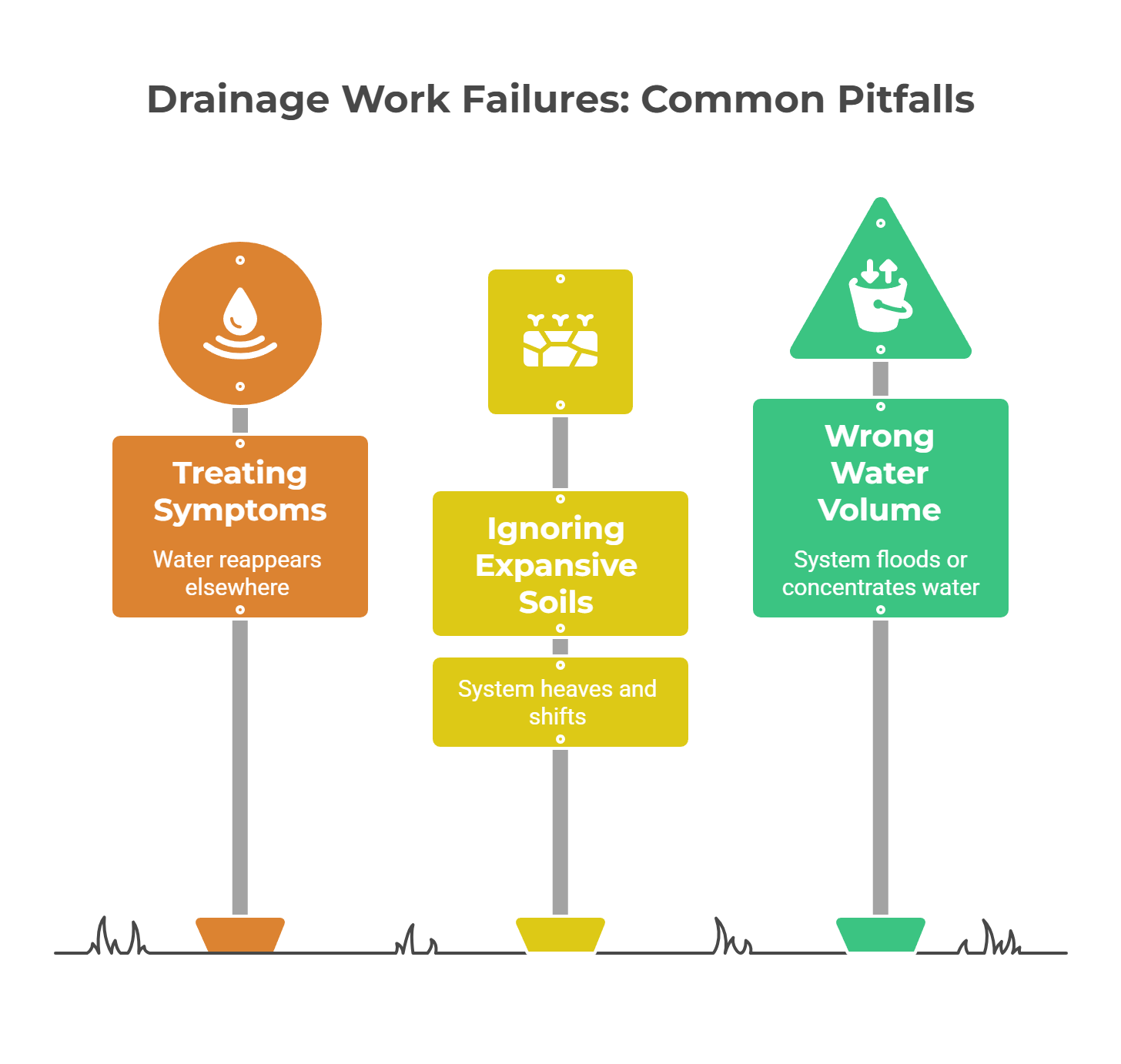
Three failures show up repeatedly when diagnosis gets skipped.
Treating Symptoms Instead of Sources
When a contractor sees standing water or a wet basement and installs a solution aimed at what is visible, the water often reappears somewhere else within a season. The source was never identified. A surface drain installed without understanding the upstream grade, soil saturation rate, or inlet capacity is a good example.
That drain can back up or redirect water toward the foundation rather than away from it, turning a manageable drainage issue into a structural one.
Ignoring Colorado's Expansive Soils
Front Range soils aren't like soils in most other parts of the country. The expansive clay common in Boulder and Denver swells when it takes on water and shrinks back when that water leaves. Drainage systems installed without accounting for that movement can heave, shift, or lose their grade over time.
A drainage contractor without decades of Front Range jobsite experience may not factor soil behavior into the design at all, which means the system is already compromised before the first storm season.
Designing for the Wrong Water Volume or Flow Path
A system sized for average conditions will fail during Colorado's heavy spring runoff and summer storm events.
Snowmelt, irrigation, rainfall, and water shed off the house all add volume that a guessed-at design won't handle. Without a site diagnosis that maps actual flow paths, seasonal volume, and soil absorption rates, a contractor is estimating capacity in the dark.
The result is either a system that floods during peak events or one that concentrates water at the wrong point on the property.

What a Proper Site Diagnosis for Drainage Work Actually Includes
We take a thorough, methodical approach to investigation before we design anything. We approach problems thoroughly and scientifically, taking the time to diagnose and understand the issue fully before implementing the solution.
That's the reason our drainage and grading services hold up over time.
Before we recommend a solution, we understand how water behaves on that specific property. That process includes:
- A full property walk to trace where water enters, accumulates, and exits the site.
- A grading assessment relative to the foundation, identifying any slopes that direct water toward the structure rather than away from it.
- An evaluation of soil composition, drainage capacity, and expansion potential, because clay behavior changes what will and won't work.
- A review of existing drainage infrastructure, including any buried pipe, swales, or outlets already on the property, and whether they're working or failing.
- An assessment of downspout routing and hardscape runoff, because rooflines and paved surfaces often contribute more water than the surrounding grade.
- An evaluation of seasonal and storm-event water behavior, not just current conditions, because a dry-day site visit misses the story entirely.
No solution gets designed until every one of those steps is complete. This is why we diagnose before we design, and it's what separates a system built to last from one built on assumptions.

The Connection Between Drainage and Foundation Damage
Poor drainage and grading sends water into the clay soils underneath and alongside a foundation. Saturated clay expands, pressing laterally against foundation walls. Then it dries and contracts, pulling away. That cycle of pressure and release is what causes cracking, settlement, and water intrusion over time. Drainage failure isn't just a wet-yard problem. It's a structural risk.
This holds up on nearly every job we take on: we almost never go to homes in Colorado that have a foundation problem and good drainage. Those two things just seldom exist together. When drainage work gets skipped or done without a real diagnosis, the foundation stays exposed to the water that's driving the structural damage.
Our foundation repair page covers what that damage looks like and what correcting it actually requires. For homeowners dealing with water intrusion at the wall level, our basement waterproofing work often runs parallel to exterior drainage corrections for the same reason.
What Happens After Drainage Work Fails
The sequence is predictable. The original problem persists or shifts to a new location. The homeowner calls the contractor back.
The contractor either patches the system or walks away. At that point, the homeowner is carrying the original drainage problem, a failed installation to remove or route around, and an extended window during which the foundation has been sitting in the water that should have been redirected months ago.
We have corrected failed drainage work from other contractors many times. The pattern is consistent: the work was done without understanding the source.
The cost of ignoring drainage problems in Colorado compounds every season the problem goes unresolved, and rework is always more expensive than doing it correctly the first time.
How We Approach Drainage Work Differently
We don't begin designing a drainage solution until we understand the complete water story of the property. That's not how every drainage contractor operates, but it's how we have operated since 2001. The drainage solutions we offer are the most ironclad, guaranteeable, and longest-lasting waterproofing solutions available, and that's only possible because diagnosis precedes design on every project we take on.
We're a 22-person company. Our field estimators, Tim and Lance, have each been with us for more than 20 years. We hold an A+ rating with the Better Business Bureau and maintain high Google ratings from verified customers. We have never had a callback from a moving pile or pier, and the same diagnostic discipline carries through to every drainage project. We only want to fix anything once.
We also won't lower our scope to compete on price. We're never going to lower our scope or our standards. If someone chooses us, they're lucky, because we'll deliver a great job and the perfect solution. If you want to understand what is actually happening with water on your property, contact us to schedule a site assessment. We'll walk the property, trace the water story, and tell you what we find before any work begins.
You can also read more about our team and how we work.
A Note for Structural Engineers and Engineer-Referred Clients
Engineers who refer clients to us do so because we execute engineered plans precisely, without substitutions or shortcuts. Proper site diagnosis is what makes accurate plan execution possible from day one. A contractor who skips diagnosis may install the right system in the wrong location or at the wrong grade, undermining an engineer-specified design before the first rain event.
We're a member of the International Society of Micropiles and the Associated General Contractors of America. Our micropile installation work follows the same diagnostic and execution discipline we apply to drainage. If you're specifying a drainage solution and want a contractor who won't deviate from the design, we're a straightforward conversation to have.
Work at this level requires both field rigor and respect for engineering authority. We don't improvise on either.
Common Questions About Drainage Diagnosis
The Right First Step: Schedule a Site Assessment, Not a Quote
A quote without a diagnosis is a guess at a price for a guess at a solution. That's not how we work. When you contact us, the process starts with a site assessment, because we need to understand the property before we can design anything worth installing. We don't require a deposit. The signed contract is the commitment.
The site assessment is simply the entry point into a process that leads to a permanent solution.
We won't skip diagnostic steps to offer a faster or cheaper path. That's how drainage work fails. Schedule a site assessment with us to understand your property's complete water story before any solution is designed.
For homeowners in Boulder and surrounding communities, our Boulder drainage and grading page has more on what we do locally.
Key Takeaways
- Drainage work without a site diagnosis is the leading cause of drainage failure, because the solution becomes a guess rather than a designed response to the actual water source.
- Front Range soils, particularly the expansive clays common in Boulder and Denver, swell, shrink, and shift drainage systems in ways generic designs don't account for.
- Drainage failure is a structural risk, not just a landscaping issue, because water reaching the clay near a foundation drives the soil movement that causes cracking and settlement.
- A proper site diagnosis maps the complete water story of the property, including flow paths, soil behavior, existing infrastructure, and seasonal water volume, before any solution is designed.
- We have operated this way since 2001 and back it with an A+ BBB rating, verified Google ratings, and a 22-person team with deep Front Range experience.
- The right first step is a site assessment, not a price quote, because a quote before diagnosis is a price on a solution that may not fit the problem.
Related Resources
- Our drainage and grading services page details the full range of what we address on Front Range properties, from grading corrections to engineered drainage systems.
- The foundation repair page explains what happens structurally when drainage problems go unresolved and what correcting that damage involves.
- For a closer look at what poor drainage decisions cost over time, read our piece on the cost of ignoring drainage problems in Colorado.
- If you're weighing drainage system options, our comparison of French drains vs. surface drains for foundation drainage walks through where each approach works and where it doesn't.